What Is an Emotion?
We all have emotions.
While most of us can name the core emotions — anger, sadness, joy, fear, shame, love — not everyone can feel their emotions, understand them, work with them in healthy and helpful ways, to clearly extract the messages that emotions have for us.
A client recently asked me during an emotional clearing session:
“What actually is an emotion? Where does it come from?”
We were already 5 sessions into the Spiral — and half-way through the process of “root clearing” the 22 core emotions. He is more scientifically minded (which I love) and wanted to understand how these emotions that we were activating, mapping and releasing were able to be felt.
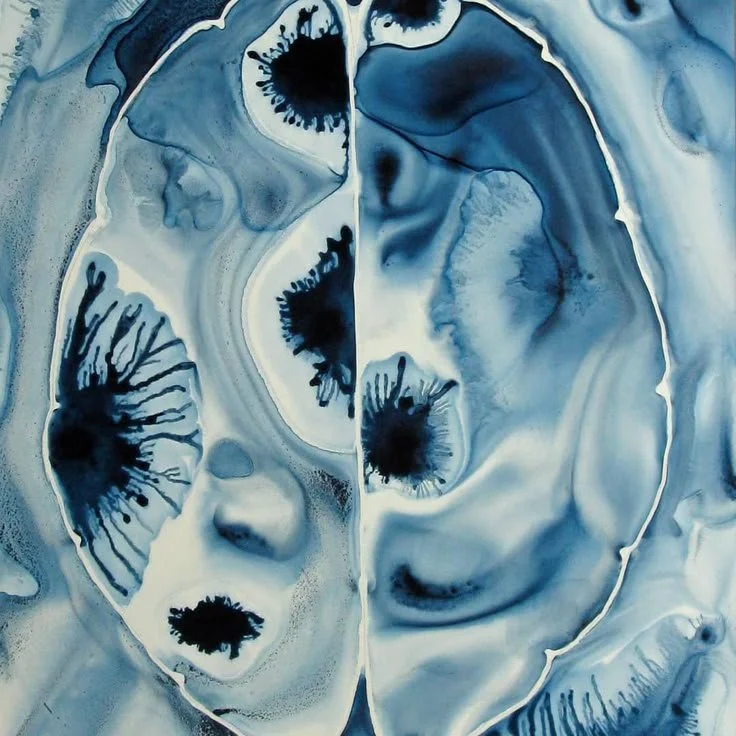
Art: Ink Brain Scan by Michele Banks
The Science of Emotion
At its core, an emotion is simply a biological and chemical reaction occurring in our body in response to an internal or external stimulus.
We might notice our emotions when they are associated with a corresponding physical sensation, but we can also be completely unaware of our emotions. Even if we’re not conscious of our emotions, they are still driving our thoughts and behaviours, and vice versa, so better understanding emotions can provide more clarity and conscious control over our choices.
How does an emotion come about?
When you encounter a situation — whether it’s being completely alone in your house, noticing a raised eyebrow from your boss, hearing your partner mutter some words under their breath or receiving an unexpected hug from someone you’ve just met — your brain rapidly processes the information from three sources:
The external environment — what you’re experiencing through your senses: sight, sound, smell, touch, taste
Your internal environment — autonomic nervous system processes like your heart rate and circulation, body temperature, hormones, digestion
Stored memory — how similar events felt in the past and what outcomes were registered
And it doesn’t always take an external trigger.
Just thinking about a person, replaying a past event, or worrying about a potential future situation can spark the same chain reaction in your body, producing emotions that you’ll link to those thoughts.
The brain doesn’t always distinguish between what’s happening in front of you and what you’re picturing in your mind, so memory and imagination can create real emotional responses too.
The environment, internal state, and stored memory are always working together to generate emotions, but it's not always in the neat, linear order of external trigger → internal response → meaning order that you might expect.
All of this touches on your nervous system regulation and the stress response, as well as visualisation and manifestation practices, which I’ll expand on another time, but let’s stick to emotions for now!
Some of the key brain structures that work together to generate emotions include:
Amygdala – detects potential threats or rewards and triggers quick emotional responses.
Hippocampus – ties the emotion to memory, so past experiences influence how you feel now.
Prefrontal cortex – helps regulate and interpret emotions, deciding how (or if) to act on them.
Underneath all of this processing is a cascade of neurochemistry.
Neurotransmitters like dopamine, serotonin, and norepinephrine shift our internal state, influencing whether we feel alert, content, fearful, or energised.
Hormones like cortisol (stress) or oxytocin (connection) join in, amplifying the body’s response.
How your brain is able to process this information and the specific cocktail of neurochemicals it produces depends on the state of your health — your diet, sleep quality, water intake, how much inflammation is occurring in your body’s tissues, nutrient levels, diseases or pathogens your immune system is dealing with, etc.
It’s also influenced by the patterns of thoughts and behaviours that you’ve practiced — whether intentionally or not — for months, years or decades.
It’s all so inextricably linked and fascinating to me!
Emotions aren’t “just feelings” but whole-body, whole-brain events that help us survive, connect, and respond to the world in incredible ways that are unique to each of us as individuals.
The difference between emotions and feelings
Even though we use these words interchangeably, emotions and feelings aren’t quite the same.
Emotions are automatic, fast, and biological. As I’ve just explained, they begin in the brain and body with chemical reactions, nervous system shifts, and physiological responses. Interestingly, studies show they only last 90 seconds too!
Feelings are the conscious experience of those emotions — the names we give the sensations, and the meanings formed through the use of language, thought patterns and memories.
For example:
The emotion of fear arises as a signal to the body to avoid danger. Fear might trigger a racing heart, shorter breaths, tense muscles, sweaty palms, and a jolt of adrenaline.
You might associate these sensations with feeling “anxious,” but equally these same sensations could be felt as “excitement,” depending on how you interpret the sensation and the situation or thought that is triggering the emotion.
Understanding this distinction — between the emotion as a sensation felt in the body and the feeling as the word we use to label and describe the sensation — is powerful.
It is a reminder that while we can’t always control the raw emotional surge that arises within us, we can influence the feeling or the meaning we make of it, and therefore the choices that follow.

When a five-year-old’s emotions are still running the show
You don’t have to look too far to see just how many people struggle with their emotions.
People often seek me out when they get easily swept away by big feelings, shut down in conflict, or have emotionally fueled reactions that they later regret.
Relationships, careers, health and your self-perception can all be derailed when you have difficulty managing emotions.
I’ve been there, on the emotional rollercoaster, getting high and hopeful on a rush of joy or love, only to collapse into ineffective states when overwhelmed by fear or sadness.
It’s very human, and especially when we really aren’t taught any of this stuff, it’s easy to see why so many revert to old patterns and coping mechanisms.
The thing is, those automatic default settings are old. They’re based on the past, and usually go right back to childhood.
The highly adaptive and clever way you navigated your world as a 5 year old is not going to work for the mature adult situations you find yourself in today, yet so many adults are still operating from these childhood settings.

Emotions play a bigger role in your life than you think
With personal development often focussed on mindset and repatterning thoughts, emotions and the physical experience of them is often left out of the conversation.
But emotional patterns are often what’s getting in the way of the success that you’re trying to achieve.
You might have a sense of this, but often it is unconscious beliefs, thoughts and emotions that are driving your decisions — even when you think you’re being rational.
Whether it’s your business or career, relationships, finances, health and fitness, or your sense of self, these emotions are playing a bigger role than you might think.
Your emotions aren’t obstacles or enemies to be feared or suppressed though. They are simply signals from your brain and body, carrying important intel that you can learn to work with.
I work with emotions every day, but I’ll admit I don’t often stop to think about biology or neuroscience underlying it anymore.
And you don’t have to hold onto this information either.
Once you’ve built the structure in your mind with knowledge, and used reflective experience to integrate it, this stuff becomes second nature.
Just like driving a car, you need to know how to operate a vehicle, learn the road rules and spend time behind the wheel practicing. After a while, you barely think about driving, you just do it.
Learn to harness emotions instead of being hijacked by them
If you’re curious to understand your own emotions — what they are, how they arise, and most importantly, how to work with them so you don’t miss important intel or get overwhelmed by their intensity, I’m creating a new 7-day email course on understanding your emotions.
Across seven short lessons, you’ll:
Learn the science behind emotions in simple, practical language.
Build emotional literacy so you can name and navigate what’s happening.
Gain tools to hold, process, and move through feelings without avoiding or collapsing into them.
Once you understand your emotions, you can harness them, instead of being hijacked by them.
Get in touch if you want to have free access to the first round.